
“He won’t say a word outside the house”: apps for shy kids, what actually helps (and what doesn’t)
By the Life Scenario team · Published · For parents of children 6–14
Are there apps that actually help shy kids?
The apps that help a shy child most make them answer “Hi, can I sit here?” in their own words, not just watch or tap. Calm-down apps help with nerves, video-modeling apps show what to do, and practice with real people still matters most. Start small.
Key takeaways
- Shyness is common and is not a problem to fix. The goal is that it doesn’t stop your child doing things they want to do.
- Different apps do different jobs: calming the body, showing what a situation looks like, or getting your child to produce the words themselves.
- Watching and tapping teach a child to recognize the right move. Saying the words, again and again, is what makes them come out when it counts.
- No app replaces small, real steps with real people: saying hello to a neighbor, ordering a drink, asking a teacher one question.
- If shyness is stopping your child from going to school, eating in front of others or answering people they know, talk to a professional rather than buying another app.
What a shy child actually needs to practice
A shy child is uncomfortable in unfamiliar situations or when they feel “on show”: meeting someone new, answering in front of the class, ordering food. Most children feel shy some of the time. For some, it gets in the way of friendships and clubs, and each freeze makes the next one more likely.
What breaks that cycle is small, repeated success. Health services that advise parents on shyness suggest small goals, like a first “hello”, with praise for each step. Child Mind Institute clinicians describe scripting, role-play and talking through what will happen as useful tools for children who find social situations hard. That is what to look for in any app: does it help your child take a small step and say the words, or does it only explain what the words should be?
An app can be a good rehearsal space because nobody is watching and a mistake costs nothing. The real test is still the lunch table, the café counter and the classroom, so treat any app as a warm-up.
The kinds of apps for shy kids, and what each is good for
Calm-down and regulation apps. These teach a child to settle their body before or after a hard moment: breathing, audio stories, short meditations, games about noticing feelings. Moshi offers audio stories, meditations and sleep content on a subscription. Mightier, for ages 6–14, uses games controlled by a heart-rate band to practice calming down, on a monthly membership. The Zones of Regulation app is a self-regulation game sold as a one-off purchase. These help with the racing heart before a party or a presentation. They aren’t designed to help with what to say once your child gets there.
Video-modeling and tap-to-answer social-skills apps. Your child watches a short scene or reads a situation, then picks the best response from a few options. Model Me Kids uses videos of real children modeling social situations. Everyday Speech offers video-modeling lessons and games, mostly used by schools and speech therapists. Social Quest from Smarty Ears has illustrated school and social scenarios with a choice of answers, as a one-off purchase for iPad and Mac. Centervention’s Zoo U is an online game where children choose responses in social scenes, sold to schools. They are useful for understanding what a situation looks like and which responses exist. Choosing the right answer from a list is still easier than coming up with it yourself when your throat is tight.
Practice games where the child answers in their own words. Here the child hears or reads a situation and has to produce the reply themselves, out loud, then gets feedback. Life Scenario is one option in this group: your child hears a real-life situation, answers aloud, gets feedback on what they said and can try again, and you get prompts for a short conversation afterwards. There are five free scenarios with no card needed to start, and no subscription: you buy credit packs only if you want more. This kind of practice is aimed at the gap between knowing the right answer and actually saying it.
Human options. A social skills group, often run by schools or counselors, gives children practice with peers. A psychologist or counselor can help when shyness shades into anxiety. Drama, improv, scouts and team sports give a shy child a role and a script, which makes joining in easier. For some children, these do more than any app.
4 things a shy child can practice saying first
1.“Hi, can I sit here?”
The most useful sentence in a school day. It is short enough to say with a tight throat, and a no is about the chair, so it stings less.
2.“Can I have the pasta, please?”
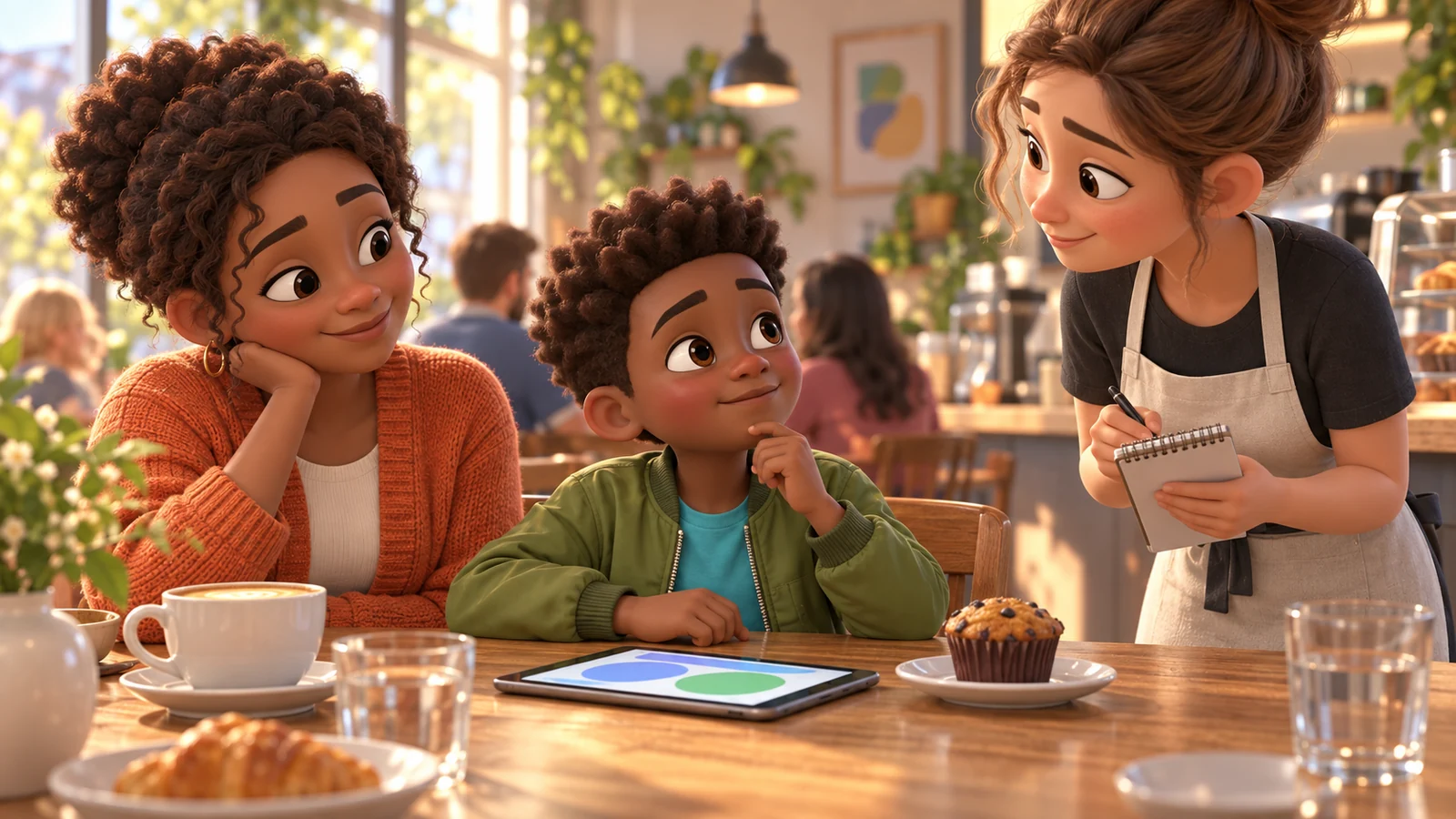
Ordering food is a low-stakes place to start, because the other person is paid to be friendly. Let your child order for themselves, even in a whisper, instead of ordering for them.
3.“Can you help me with this?”
For the teacher. Many shy children would rather get something wrong than ask. Practice the exact words at home so the question is ready before the lesson.
4.“I don’t know yet. Can I think?”
For being put on the spot in class or by an adult. It buys time without freezing and shows that a pause is allowed, which takes away much of the pressure.
What not to say (and what to say instead)
“Don’t be shy!”
“Take your time. Say hi when you’re ready.”
Telling a child not to feel something adds pressure to the feeling; giving them time lowers it.
“She’s just shy.”
“She likes to watch first.”
Children tend to live up to labels, and the second version describes something she does rather than who she is.
“Go on, say thank you to the lady.”
Agree the line in the car: “When we get the food, you say thanks.”
Prompting in front of the other person puts your child on show; a plan made in private does not.
Ordering for them to save the moment
“I’ll wait. Tell her what you’d like.”
Every time you step in, your child misses a small, safe chance to practice.
“You were so quiet at the party.”
“I saw you ask Leo about his dog. That was brave.”
Noticing the one thing they did builds the next step; noticing what they didn’t do makes the next party harder.
| Instead of | Try | Why |
|---|---|---|
| “Don’t be shy!” | “Take your time. Say hi when you’re ready.” | Telling a child not to feel something adds pressure to the feeling; giving them time lowers it. |
| “She’s just shy.” | “She likes to watch first.” | Children tend to live up to labels, and the second version describes something she does rather than who she is. |
| “Go on, say thank you to the lady.” | Agree the line in the car: “When we get the food, you say thanks.” | Prompting in front of the other person puts your child on show; a plan made in private does not. |
| Ordering for them to save the moment | “I’ll wait. Tell her what you’d like.” | Every time you step in, your child misses a small, safe chance to practice. |
| “You were so quiet at the party.” | “I saw you ask Leo about his dog. That was brave.” | Noticing the one thing they did builds the next step; noticing what they didn’t do makes the next party harder. |
What do I say when my child refuses to practice?
Shy children often hate being coached, because practice feels like another performance. Make it small and make it a game. Take turns: you play the shy one who mumbles, they play the confident one. Children often find it easier to coach a parent than to be coached.
Keep sessions to a few minutes and stop while it is still easy. If your child uses an app, sit nearby, ask afterwards which situation was hardest, and pick one small real version of it for the week.
When an app is not enough
Most shyness eases with gentle practice and time. Some children need more than that. Talk to your doctor, school counselor or a psychologist if your child cannot answer people they know well outside the home, avoids school or parties because of fear, has stomach aches or tears before every social event, or if shyness is getting worse rather than better.
Counselors and psychologists can offer relaxation and stress-management strategies, counseling and social skills training. An app can sit alongside that as extra practice, but it shouldn’t delay getting that help.
What if the app works at home but not at school?
What if my child does well in the app but still freezes in real life?
That is normal, and it is the gap every rehearsal has to cross. Pick one real situation a week that matches something they practiced, and make it small. The app has done its job if the words are there; using them in public takes a few tries.
Is screen time a problem for a shy child?
It depends what the screen time replaces. Short practice sessions that end with something real to try are different from hours alone, so keep them short and in a shared room.
What if my child wants to use the app instead of seeing people?
Then the app has become a place to hide. Tie each session to a real step: practice asking to sit down tonight, try it at lunch tomorrow.
When should I involve the school?
If your child doesn’t answer teachers or classmates at all, or avoids school, tell the teacher. Schools can often arrange a buddy, small-group activities or a quieter way to answer in class while your child builds up.
What to say at 6–8, 9–11 and 12–14
- 6–8
- Shyness is often about new places and new adults. Play, puppets and pretend shops work better than any app. Practice greetings and ordering, and let your child hide behind you for a moment before they try.
- “Hi. My name is Sam.”
- 9–11
- Classroom moments matter more: answering questions, group work, asking for help. Short practice apps can help here, as long as each session leads to one real try that week.
- “Can I be in your group?”
- 12–14
- Shyness often shows up as fear of being judged. Your child may reject anything that feels babyish, so let them choose their own words and tools. Clubs built around an interest take the pressure off small talk.
- “Are you doing the robotics club too?”
| Age | What changes | Line to try |
|---|---|---|
| 6–8 | Shyness is often about new places and new adults. Play, puppets and pretend shops work better than any app. Practice greetings and ordering, and let your child hide behind you for a moment before they try. | “Hi. My name is Sam.” |
| 9–11 | Classroom moments matter more: answering questions, group work, asking for help. Short practice apps can help here, as long as each session leads to one real try that week. | “Can I be in your group?” |
| 12–14 | Shyness often shows up as fear of being judged. Your child may reject anything that feels babyish, so let them choose their own words and tools. Clubs built around an interest take the pressure off small talk. | “Are you doing the robotics club too?” |
Key terms
- Video modeling
- Learning a social skill by watching a short video of someone doing it well, then copying it.
- Tap-to-answer app
- An app where the child reads or watches a situation and picks a reply from a list of options.
- Social skills group
- A small group, often run by a school or counselor, where children practice social situations together with an adult guiding them.
- Small steps
- Breaking a scary situation into tiny goals, like one hello, and praising each one before moving to the next.
Questions parents ask
What apps help shy kids with social skills?
It depends on the job. Calm-down apps such as Moshi or Mightier help with nerves, video-modeling and tap-to-answer apps such as Model Me Kids or Social Quest show what to do, and practice games where your child answers in their own words help them actually say it. Many families combine one app with small real-life steps.
Can an app help my child be less shy?
An app can help your child rehearse, which makes real situations feel more familiar. What changes shyness over time is small, repeated real-world success. Use an app as a warm-up, then plan one real try each week.
What do I say to my shy child before a party?
Talk through what will happen, who will be there, and one line they can use: “Hi, what are you playing?” Agree that watching for a while first is fine. Skip “don’t be shy”, which adds pressure.
Is my child shy or anxious?
Many children are shy in new situations and warm up with time. It is worth talking to a professional if fear stops your child doing everyday things, like answering people they know, going to school or eating with others, or if it is getting worse.
What do I say when my shy child won’t order at a restaurant?
Agree the exact words before you go in, then wait instead of ordering for them. A whispered order still counts. Praise it afterwards, not in front of the server.
Related
Sources
- Better Health Channel (Victorian Department of Health, Australia) — Children and shyness (2012): A shy child is anxious or inhibited in unfamiliar situations; most children feel shy sometimes, but severe shyness can limit a child’s life. The page advises not labelling a child as shy, setting small goals such as saying hello, praising progress, and considering professional help (counseling, relaxation strategies, social skills training) in severe cases.
- Child Mind Institute — Helping young children who are socially anxious (2026): Scripting, role-playing and previewing what will happen are described as tools for children who find social situations hard, along with small steps, praise and finding a buddy; many children want to observe before joining in.