
Games that teach good sportsmanship: 9 to play at home
Life Scenario team · Published · Ages 6–14
Which games teach kids good sportsmanship?
Start with luck games such as Snakes and Ladders or Sorry! from Hasbro, where losing is nobody's fault. Add cooperative games such as Outfoxed! from Gamewright, where everyone wins or loses together. Then move to skill games like chess. Practice one line each round: “Nice move” or “Can we agree the rules first?”
Practise a situation like this with your child — no sign-up →
Key takeaways
- Sportsmanship is learned by losing often, in small ways, with an adult nearby who stays calm.
- Begin with games of luck. Children find it easier to lose when the dice decided.
- Cooperative games let a child practice the words of fair play without a loser at the table.
- Agree the rules and the number of rounds before you start. Many arguments start with a rule nobody settled.
- Pick one line to practice per game and say it yourself first.
Why does the order of games matter?
Because losing at chess and losing at Snakes and Ladders are different experiences. Raising Children Network, the Australian parenting site, points out that children, and adults too, find it easier to lose a game of luck than a game of skill, since losing at luck says nothing about your ability. Its advice for a child who struggles with losing is to play games of chance first and build up to skill.
The same guidance has a short checklist for any competitive game. Is it suitable for the child's age? Does the child have a real chance of winning? Is everyone playing fair? A seven-year-old who loses every game of chess to a twelve-year-old sibling is not learning sportsmanship. They are learning that they lose.
The games below follow that order: luck, then cooperation, then skill. Stay at each stage until losing a round no longer ends the evening.
3 games of luck to start with
Snakes and Ladders. Nothing but dice. A child can be winning and slide down a snake two squares from the end, and nobody did it to them. Raising Children Network names it as a good game of chance, and it suits children who are still learning to wait for a turn.
Snap. A card game that is over in minutes, so there are many small wins and losses in one sitting. Short games matter at this stage. Ten quick losses are easier to take than one long one.
Sorry! (Hasbro, 2 to 4 players). Players race their pawns home and can bump each other on the way. Being bumped by another player is the exact moment a sore loser needs to practice, and here the rules make it happen again and again.
3 cooperative games where everyone wins or loses together
Charades. Raising Children Network lists it as a cooperative game. Play it without scores: the aim is for the group to guess as many as it can. Children practice cheering for someone else's turn.
Outfoxed! (Gamewright, ages 5 and up). A cooperative whodunit in which players collect clues and rule out suspects together before a fox escapes with a stolen pie. When the team loses, it loses to the game, and the conversation is about what to try next time.
Forbidden Island (Gamewright, ages 10 and up). A cooperative game for older children in which a team collects four treasures from a sinking island. It adds disagreement about strategy, so there is practice at accepting that the group went with someone else's plan. For more games of this kind, see our list of social skills games.
3 games of skill for when your child is ready
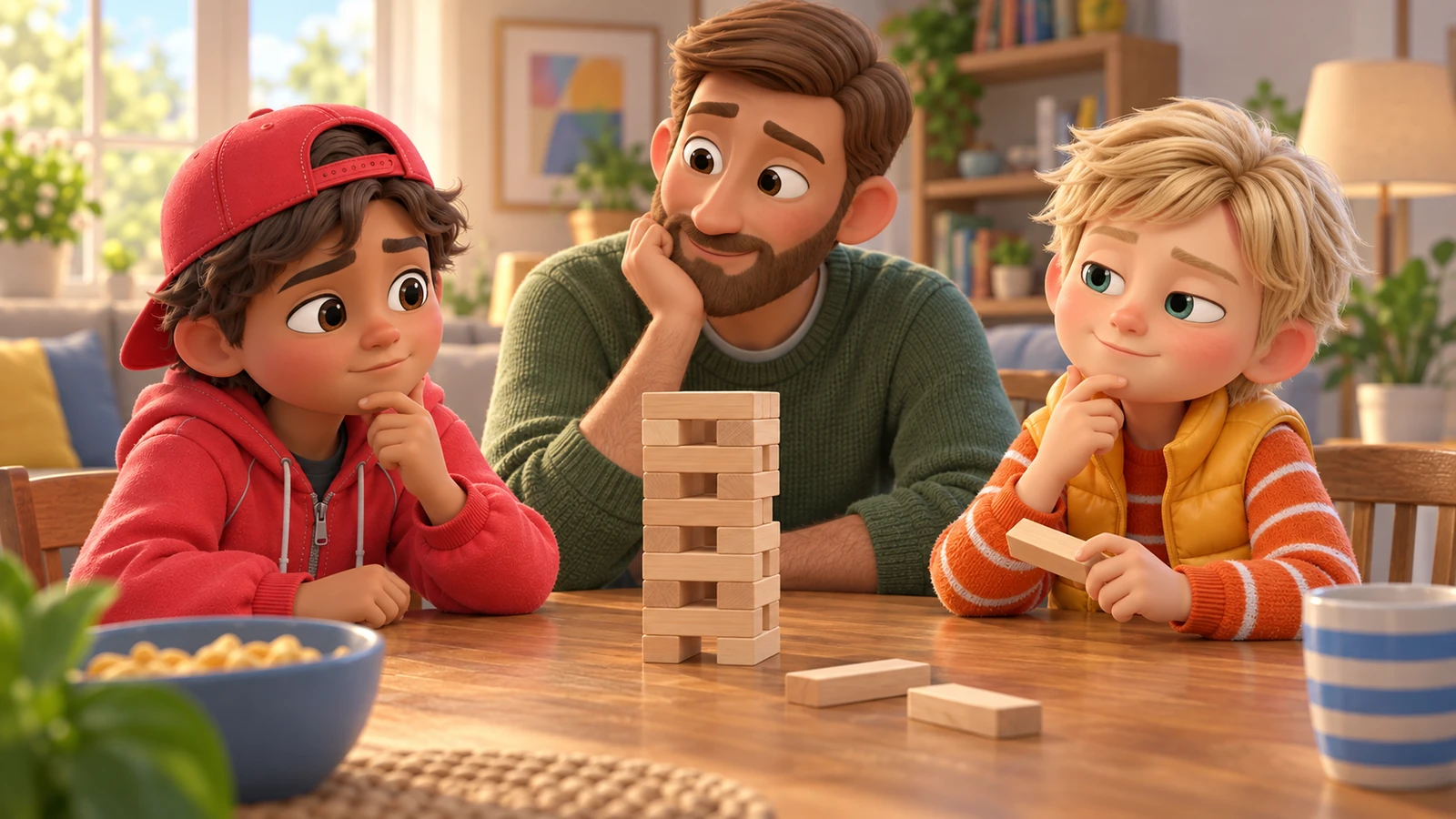
A block-stacking tower. Players take turns pulling one block from a tower and placing it on top, until it falls. There is one loser and a loud crash, which makes it a good first skill game: the loss is sudden, funny and over quickly.
Checkers or chess. Pure skill, no luck to blame. Play these only when the players are roughly matched, or agree a handicap openly before you start, such as the stronger player beginning with fewer pieces.
Three-shot shoot-out with a referee. In the garden or the park, take three shots each at a goal, and rotate the job of referee every round. The referee's call is final. Having to make a close call yourself is a good way to learn how hard it is.
5 things your child can say during a game
1.“Can we agree the rules first?”
For the start of any game. Settling the rules and the number of rounds before the first move removes the most common cause of arguments later.
2.“Nice move.”
For when the other player does something clever, especially something that hurts your child's position. It is a hard compliment to give, which is why it is worth practicing.
3.“Ugh. Okay. Your turn.”
For a bad roll or a lost piece. It lets the frustration out in one syllable and then hands the game on, which is all that good sportsmanship asks in the middle of a round.
4.“I need a minute.”
For when anger is rising. Agree in advance that anyone can call a one-minute break. Leaving the table for a minute is very different from quitting.
5.“You got me. Good game.”
For the end of a loss. Rehearse it before the game starts, while your child is calm, so that the words are ready when they are not.
A game at home practices the losing. The words for a disputed call, with the family watching, are a separate skill. In Life Scenario your child hears a moment like this one: in a family soccer game you kick the ball into the goal, and your older brother says it didn't go in. They answer in their own words, get gentle feedback and can try again.
No sign-up · about 2 minutes
What not to say (and what to say instead)
| Instead of | Try | Why |
|---|---|---|
| “It's only a game.” | “You really wanted to win that one.” | To your child it was not only a game. Naming the disappointment helps more than arguing with it. |
| “If you're going to behave like that, we're never playing again.” | “We'll stop for today and try a shorter game tomorrow.” | A child who never plays never practices losing. Ending calmly and coming back is what teaches. |
| “I'll let you win this time.” | “Let's play one where the dice decide.” | Raising Children Network says letting a young child win now and then is fine, but letting them win all the time makes real losses harder and real wins less satisfying. |
| “Don't be a sore loser.” | “What could you say to her now the game's over?” | The label gives your child nothing to do. A prompt for one sentence does. |
| “Who won?” (first question after a match) | “What did you do well today?” | Nemours KidsHealth suggests asking what went well and what your child would like to do better, so the result is not the only thing that counts. |
What do I say when my child loses and falls apart?
Very little, at first. “That was a tough one.” Help them calm down, and leave the lesson for later. Raising Children Network's advice is to wait until a very upset child is calm and then help them understand the feeling. Strong emotions during play are okay. Throwing the board is not.
When it is calm, go back over it briefly: “When you landed on the snake, what could you say next time?” Agree one line. Then play again within a day or two, a shorter game, so the last memory of games is not the meltdown.
Listen for what is underneath. “It's not fair” after a loss is sometimes about the rules and sometimes about something else, and we have a separate page for it. A child who cannot calm down after ordinary disappointments may need more help with big emotions in general.
If your child cheats and then denies it, treat the two things separately. Restate the rule and carry on, and deal with the denial later as you would any case of lying to avoid trouble.
What if my child still can't lose?
What if my child cheats to win?
Stop the game and state the rule once: “One throw each turn. That's what makes it fair.” If it carries on, Raising Children Network suggests sitting the child out for the rest of the game and discussing it once they are calm. Next time, ask them to help set the rules before you start. Children are more likely to follow rules they had a say in.
What if my child quits as soon as they fall behind?
Shorten the game and agree the number of rounds in advance: “Three rounds, and we finish all three.” Use luck games, where the lead changes often. Praise finishing more than winning.
What if a sibling always wins?
Change the game, not the child. Use games of chance or cooperative games when the age gap is large, or put the siblings on the same team against a parent.
When should I ask for more help?
If losing regularly leads to hitting, breaking things or distress that lasts for hours, or if the same thing is happening at school and costing your child friends, speak to the teacher and your child's doctor or the school counselor.
What to say at 6–8, 9–11 and 12–14
| Age | What changes | Line to try |
|---|---|---|
| 6–8 | The youngest children in this group can still find formal rules hard, so keep games simple and short: Snakes and Ladders, Snap, Outfoxed!. Stay in the game yourself and model the lines. | “Good game. Again?” |
| 9–11 | Skill games and team sports start to matter, and so does being seen to lose. Practice compliments to the winner and accepting a referee's call. Let them referee a round. | “Nice move.” |
| 12–14 | The stakes are social. Strategy games such as Forbidden Island or chess suit this age, played as equals. Discuss examples from sport they watch: what did that player do after losing? | “You got me. Well played.” |
Key terms
- Sportsmanship
- Treating other players, teammates and officials with respect, whether you win or lose.
- Game of chance
- A game decided by luck, such as Snakes and Ladders or Snap. Losing says nothing about the player's ability.
- Cooperative game
- A game in which all the players work toward one goal and win or lose together.
- Handicap
- An open, agreed adjustment that evens up a game between players of different ages or skill.
Give your child 5 free practice scenarios
No card to start. No subscription, ever.
Try one short round together. Your child hears a situation such as an older brother saying their goal did not count while everyone is watching, says what they would do, and gets gentle feedback with a chance to try again. You get a few prompts for a short conversation afterward.
Start practising freeQuestions parents ask
What games teach good sportsmanship?
Luck games such as Snakes and Ladders, Snap and Sorry! for practicing small losses, cooperative games such as charades and Outfoxed! for practicing fair play without a loser, and skill games such as chess once your child can lose a round calmly.
Is it okay to let my child win sometimes?
Yes, now and then, particularly with young children playing against older people. Raising Children Network cautions against doing it all the time, because children then find real losses harder and real wins less satisfying. A luck game gives fair wins without any pretending.
What do I say when my child cheats to win?
“One throw each turn. That's the rule we agreed.” Say it once, calmly, and carry on. If the cheating continues, end the game for today without a lecture and involve your child in setting the rules next time.
What do I say when my child quits because they are losing?
“We said three rounds. Let's finish, and then you choose the next game.” Agreeing the length beforehand makes this possible. If they cannot finish, stop calmly and play a shorter game tomorrow.
Are cooperative games better than competitive ones for sportsmanship?
They are a good step, not a replacement. Cooperative games let children practice encouraging others and coping when the group loses. Children also need some competitive play, because that is what recess and sport will ask of them.
How do I teach a young child to lose gracefully?
Play very short luck games often, lose cheerfully yourself, and practice one sentence, “Good game”, before you start. Praise the sentence when you hear it. Expect it to take many games.
What should I say after my child's game or match?
Ask what they did well and whether there is anything they would like to do better, as Nemours KidsHealth suggests. Leave the score until they bring it up. If they want to improve something, offer to practice it together.
Sources
- Raising Children Network (Australia) — Playing fair: tips for kids & parents (2025): Children find it easier to lose a game of luck than a game of skill, so parents can start with games of chance such as Snakes and Ladders or Snap and build up to skill games; rules should be agreed before a game; children who have a say in the rules are more likely to follow them; letting a child win all the time makes it harder for them to learn they will not always win.
- Nemours KidsHealth — Teaching Your Child to Be a Good Sport (2023): Sportsmanship means players and spectators treating each other with respect; children learn it from the adults around them; after a competition parents can ask what the child did well and what they wish they had done better instead of focusing on who won.
- Hasbro — Sorry! Game: instructions and rules (opened 2 October 2026) (accessed 2026): Sorry! is a game for 2 to 4 players in which players bump, slide and switch until somebody gets all their pawns home.
- Gamewright — Outfoxed! (product page, opened 2 October 2026) (accessed 2026): Outfoxed! is a cooperative whodunit game for ages 5 and up in which players gather clues and work together to find the guilty fox before it escapes.
- Gamewright — Forbidden Island (product page, opened 2 October 2026) (accessed 2026): Forbidden Island is a cooperative game for ages 10 and up in which a team works together to capture four treasures from a sinking island.
Published