
How to help your child approach kids at the playground
Life Scenario team · Published · Ages 6–14
How can I help my child approach other kids at the playground?
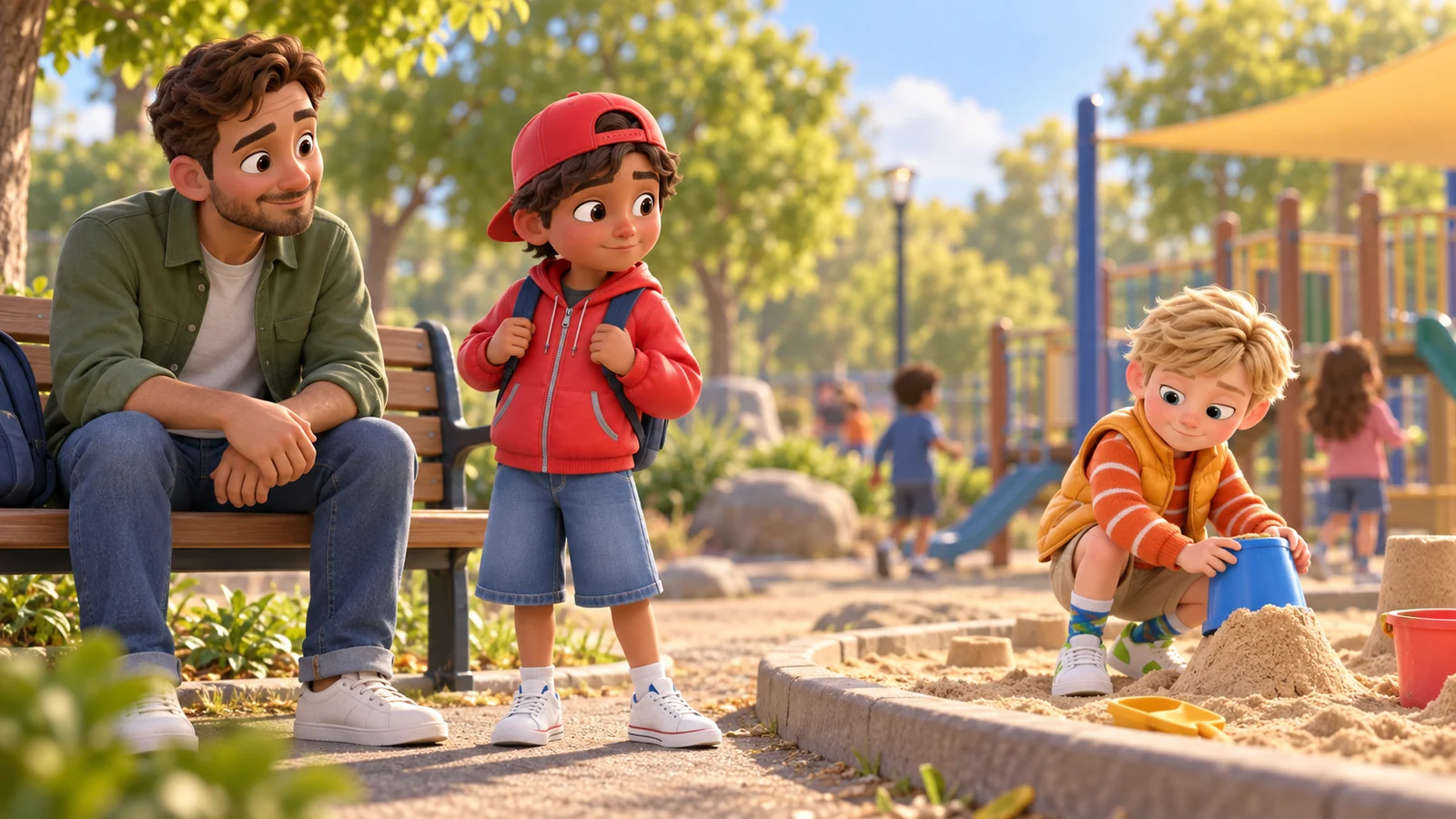
To help your child approach other kids at the playground, practice “What are you building?” or “Want to use this bucket?” Start near a shared activity and stay available. Let your child watch before joining. If an invitation is declined, help them choose another activity.
No sign-up · about 2 minutes

Key takeaways
- Ask whether your child wants help meeting someone, time to watch, or a visit spent playing with you.
- Choose a shared activity with an obvious opening instead of sending your child into the middle of a fast game.
- Offer the amount of support your child wants, such as walking nearby or helping with one introduction.
- Practice both an invitation and what to do when another child is busy or says no.
- Keep your usual playground rules about where your child can go and what personal information stays private.
An unfamiliar park asks your child to do several things at once
At a familiar school playground, your child may know the children, the games, and where the adults stand. At a new park, they have to work out all three. Staying near you for a while can be a way to understand what is happening. Ask what they have noticed before deciding that they are refusing to socialize.
A child who wants to join may still struggle to choose a moment. The children on a climbing frame could be in the middle of a chase, while someone at the sand table is making something slowly enough to discuss. Help your child notice an activity they enjoy and a place where there is room. The first step can be using nearby equipment, with no introduction at all.
Try to keep your own hopes from filling the whole visit. If you have driven across town for a playgroup, it is understandable to want a new friendship to come from it. Your child still needs an outing that is pleasant even if nobody connects today. A return visit may offer another opportunity, but you do not need to promise that repetition will produce a friend.
4 things your child can say when approaching kids at the playground
1.“What are you building?”
Use this when another child is making something and has a moment to answer. Your child can start by asking about the game.
2.“Want to use this bucket?”
Offer a shared or personal item your child is genuinely comfortable lending. The invitation creates something to do together, but your child can also set a limit and should not give away treasured things to earn company.
3.“Is anyone using this space?”
Use this before joining a table or area that looks available. It helps your child find out where they can start playing.
4.“Okay, I'm going to the slide.”
Use this after a declined invitation or when the other child is occupied. They can move on to another activity. No apology is needed.
Move from reading “What are you building” to trying the words out loud. Life Scenario gives your child a situation with something difficult to answer, then feedback, and more situations like it to practise.
No sign-up · about 2 minutes
What not to say (and what to say instead)
| Instead of | Try | Why |
|---|---|---|
“Go over there. They're waiting for you.” | “Would you like me nearby while you try?” | Tell your child where you will be if they want help. |
“Don't be shy.” | “Would you like to watch for a little?” | Watching can help a child understand the activity and choose a comfortable time to approach. |
“Give them your toy so they'll like you.” | “You can offer a turn if you want to.” | An invitation should not make access to friendship depend on surrendering possessions. |
“We came all this way and you didn't make friends.” | “Which part of the park did you enjoy?” | Leave time to enjoy the playground itself. |
What do I say when my child wants me to introduce them?
Say, “I can help with the first bit. What would you like me to do?” Agree a small action. You might walk beside them to the sand table, say hello to the nearby adult, or help ask whether a piece of equipment is free. Avoid telling the other child a long story about how shy or lonely your child is.
Before the visit, make a pretend park with cushions or blocks. You are building a road, and your child approaches with a toy car. They can ask a question, offer to add something, or start a separate road alongside yours. Respond in a friendly way, then swap roles so they can decide how much help the pretend parent gives.
Include a second round where you are leaving soon. Your child can use the exit line and choose another activity. This is an ordinary limit, and they do not have to persuade you to stay. Acknowledge disappointment and let your child choose what to do next. They may want a break from trying.
At the real park, stay within the supervision arrangement you normally use for your child's age and the setting. A new acquaintance does not change rules about leaving the area, entering a building, or sharing information. If something feels wrong, your child can come straight back to you. You can handle any necessary conversation with another adult.
What do I say when approaching other kids feels too hard?
What if my child watches for the whole visit?
Ask whether watching was enjoyable or whether they wanted to join but felt stuck. Those answers call for different help. If they wanted company, plan a smaller step next time, such as arriving with a familiar child or choosing a quieter activity.
What if a group keeps saying no?
Help your child move on instead of repeating the same request. A group may be finishing something, but repeated mocking or threats need an adult response. Do not make your child stay near an unkind group to practice being resilient.
What if my child wants me beside them throughout?
Stay nearby while the children begin playing. Later, ask whether they would like you to move a little farther away next time. Adjust to their needs and the safety of the setting.
When should I seek more individual advice?
If fear or difficulty joining is persistent across settings and upsetting to your child, ask school staff what they notice. A school counselor or suitable child professional can help identify useful support. A preference for a quiet park visit by itself does not tell you there is a problem.
What to say at 6–8, 9–11 and 12–14
| Age | What changes | Line to try |
|---|---|---|
| 6–8 | Choose equipment or an activity with a clear shared purpose. Stay close enough to help with an introduction and ordinary turn-taking. A short exchange followed by parallel play may suit your child better than a formal introduction. They can come back to you whenever they need. | “Can I build a road here?” |
| 9–11 | Ask your child which games they enjoy and whether they want help finding an opening. They may prefer bringing a ball or using a space where a game can begin naturally. Agree that they do not need to keep approaching the same group after a no. | “Want to try a game together?” |
| 12–14 | A park court, skate area, or organized session may provide a more natural point of contact than a younger children's playground. Keep the same principles: interest in the activity, respect for other people's time, and a clear supervision plan. Let your child choose how visible your help is. | “Is there room for another player?” |
Key terms
- Parallel play
- Doing similar activities alongside one another.
- Opening
- A pause or specific opportunity to approach, such as room at a table or a game about to start.
- Parent support
- The help a child and parent agree on, from staying nearby to assisting with a first introduction.
Give your child 10 free practice scenarios
No card to start. No subscription, ever.
Try one short round together: your child hears a social situation, answers out loud in their own words, and gets feedback. Some situations include a no, a mistake, or an awkward response to handle. Life Scenario has ten free scenarios, no card to start, and no subscription; you can use the feedback for a short conversation afterward.
Start practising freeQuestions parents ask
How do I help my child approach kids at the playground?
Ask whether they want your help, then look for a shared activity with a pause or available space. Practice one simple question. Stay available and let your child make their own introduction.
What do I say if my child asks me to do all the introducing?
Agree to help with a small first step and let them choose the next one. For example, you can ask whether a space is free, then allow the children to use it together. There is no need to withdraw abruptly.
Should I make my child play with other kids?
Ask whether they want company or are content playing alone. Some visits can simply be time to play. If they want to join but repeatedly cannot, explore what support would help.
What do I say after another child says no?
Try, “You wanted to join. That was disappointing.” Help your child choose a different activity and avoid guessing that the other child dislikes them. If there was cruelty, address that separately.
Is it okay to bring toys to help children connect?
Yes, if the setting allows them and your child is comfortable sharing. Agree what can be borrowed and what stays private. A child should not have to give away possessions to be included.
Should we return to the same playground?
If your child enjoys it, familiarity with the place and routine may make another visit easier to plan. Ask what they would like to do there. A return visit can be worthwhile even if they do not meet the same children.
Sources
- Child Mind Institute, Kids Who Need a Little Help to Make Friends (accessed 2026): Familiar settings, shared activities, and rehearsal can help a hesitant child prepare for meeting peers.
- Child Mind Institute, How to Help Kids Who Are Lonely (accessed 2026): A manageable plan can include what to do when an attempt to connect does not work out.
Published