
“What should I say?”: 30 conversation starters for kids to make friends
Life Scenario team · Published · Ages 6–14
What are good conversation starters for kids to make friends?
The conversation starters that work between kids are about something both children can see: “What are you making?”, “Can I sit here?” or “Did you understand number four?” Teach one opener, one follow-up (“What happened next?”) and one friendly ending (“See you tomorrow”), and practice all three together at home.
Practise a situation like this with your child — no sign-up →
Key takeaways
- Start with something both children can see or are doing: the drawing, the game, the worksheet.
- The opener is the easy part. Practice the second sentence, the one that follows the other child's answer.
- A short answer usually means the other child is busy or shy. It is rarely a verdict on your child.
- Give your child a friendly way to end a conversation, so stopping does not feel like failing.
- Friendships come from seeing the same child several times. One good chat is a start, and it does not need to do more than that.
Why a list of 100 questions does not help
Most lists of conversation starters for kids are written for adults to ask children at dinner: “If you could have any superpower, what would it be?” Those are fine at the table. A nine-year-old who walks up to a classmate and asks about superpowers gets a strange look.
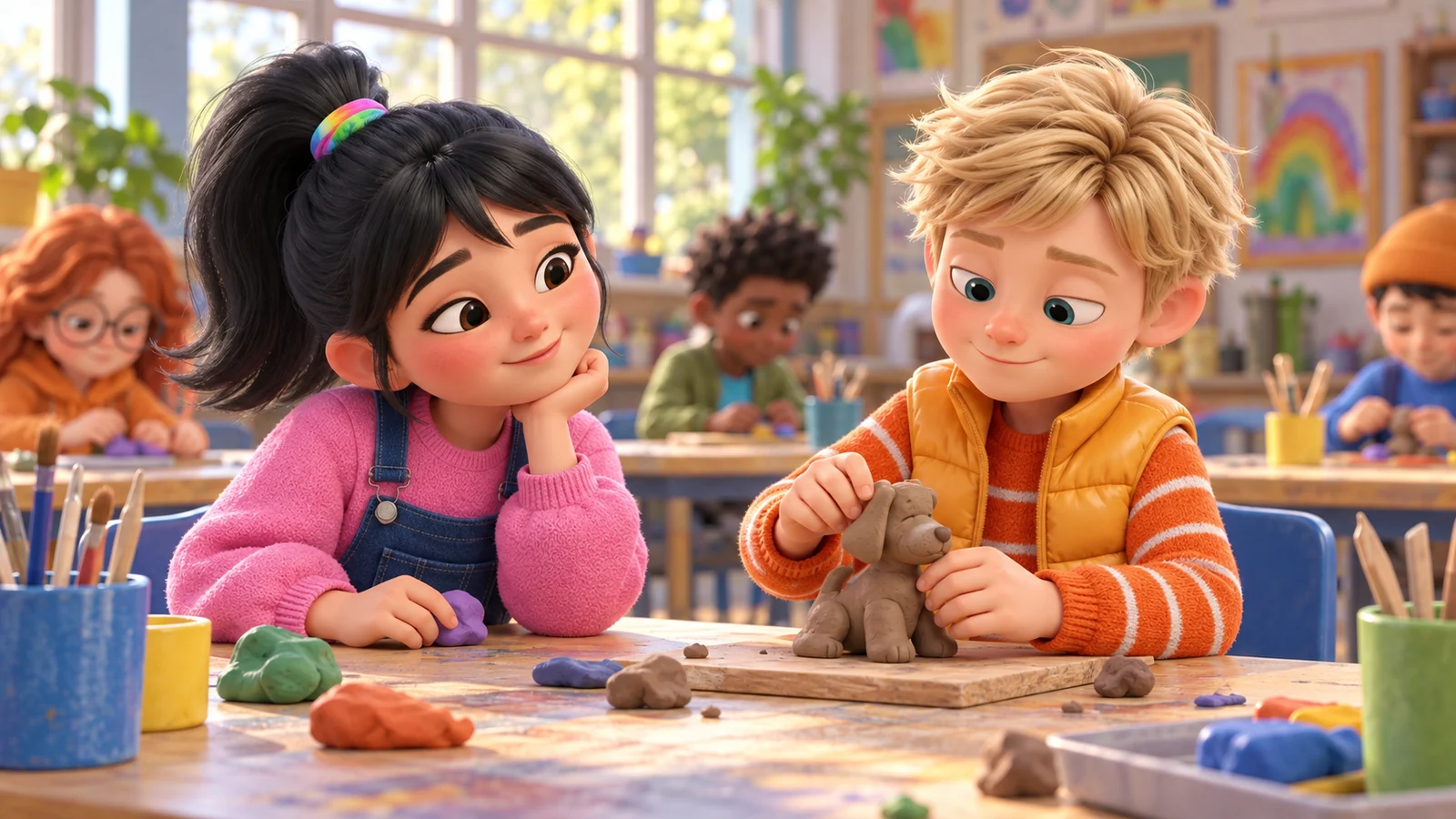
Children start conversations with each other about what is in front of them. The clay dog, the football, the homework nobody understood. A question about a shared thing is easy to answer, and it does not ask the other child to decide whether they like your child yet.
The harder moment is the one after. Your child asks, the other child answers, and now it is your child's turn again. So the practice that pays off is short: one opener, one follow-up and one way to finish. Raising Children Network, the Australian parenting site, describes conversation skills in the same terms: starting a conversation, taking turns to speak and listen, and knowing when to stop.
6 conversation starters your child can use almost anywhere
1.“What are you making?”
For anyone drawing, building or working on something. It asks about the thing and not the person, so it is easy to answer and hard to take the wrong way.
2.“Can I sit here?”
For lunch, the bus or the library. If the answer is no, it is about the chair, which stings less than a no about your child.
3.“Did you understand number four?”
For class and homework club. Admitting a small confusion invites the other child to help or to agree, and both lead to a second sentence.
4.“Have you played this before?”
For the start of a game or activity. Either answer opens a door: “Can you show me?” or “Me neither. Want to work it out?”
5.“I like your backpack. Where's it from?”
A compliment with a question attached. The question matters, because a compliment alone gets “thanks” and then silence.
6.“Hi, I'm Leo. What's your name?”
For a child your child has never met, at a club or a new school. It feels formal to adults and comes naturally to younger children.
A list gives your child the first sentence. Saying it to a child they do not know is harder. In Life Scenario your child hears a moment like this one: a new student is sitting alone at lunch, and you were about to join your usual group. They answer in their own words, get gentle feedback and can try again.
No sign-up · about 2 minutes
6 conversation starters for the classroom
“What page are we on?” “Do you want to be partners?” “What did you put for the first one?”
“That test was hard, right?” “What are you reading?” “Can I borrow a pencil? I'll give it back.”
6 conversation starters for lunch and recess
“What have you got for lunch?” “What are you playing?” “Is that game hard?”
“Want to play tag?” “Did you see what happened in PE?” “Want to go on the swings?”
6 conversation starters for a club, team or class
“How long have you been coming here?” “What position do you play?” “Can you show me how you did that?”
“What level are you on?” “Is the coach always this loud?” “Are you coming next week?”
6 conversation starters for a new school or a new kid
“Are you new too?” “Which teacher do you have?” “Where does everyone go at recess?”
“Do you want me to show you around?” “Which bus do you take?” “What's the best thing in the cafeteria?”
4 lines for keeping a conversation going, and for ending it
1.“What happened next?”
The all-purpose follow-up. It works after almost any story, and it shows the other child that your child was listening to the answer.
2.“Me too. Which part do you like?”
For a shared interest. It adds something about your child and hands the turn back, so the conversation becomes a swap and not an interview.
3.“I've never tried that. What's it like?”
For an interest your child does not share. Being honest about it gives the other child a chance to explain something they enjoy.
4.“I've got to go. See you tomorrow!”
The ending. A child who knows how to leave a conversation is more willing to start one, because they are not afraid of getting stuck in it.
What not to say (and what to say instead)
| Instead of | Try | Why |
|---|---|---|
| “Just go and say hi.” | “What's he doing? You could ask about that.” | “Hi” leaves a child standing there with nothing to add. A question about the activity comes with a next step built in. |
| “Ask lots of questions so they like you.” | “Ask one, listen, then say one thing about you.” | Question after question feels like a quiz to the other child. Taking turns is what makes it a conversation. |
| “Tell them about your Lego collection.” | “See what they're into first.” | A long speech about your child's own interest gives the other child nothing to do. Starting from theirs brings them in. |
| “Did you make a friend today?” | “Who did you chat to today?” | One conversation is something your child can achieve in a day. A friend takes weeks, so the first question sets them up to answer no. |
| “She was rude. Don't bother with her again.” | “Maybe she was busy. Try once more another day.” | One short answer tells you little. A second try on a different day is fair, and after that your child can move on. |
What do I say when my child runs out of words?
Practice the part after the answer. Put something on the table, a model or a drawing, and let your child open with “What are you making?” Answer in three words: “A bridge. For trains.” Now it is their turn. They can ask about it, say something about bridges, or say “Cool” and stop. All three are fine.
Then make it harder. Answer with one word. Mention something they have never heard of. Be busy and barely look up. Raising Children Network suggests this sort of practice conversation, with turns at asking and listening, and suggests rehearsing what a child could say before they meet someone new. Its own example is a child saying their name, mentioning their dog and asking whether the other child has a pet.
Swap roles so your child plays the one being approached. It lets them feel what a simple question is like from the other side. The Child Mind Institute notes that short social scripts like these help children practice everyday conversations before they need them.
If your child knows what to say and still does not say it at school, the words are not the problem, and a different kind of practice helps. For a move to a different school, see starting a new school mid-year. For meeting children they have never seen before at the park, see approaching children at the playground.
What do I say when the conversation goes nowhere?
What if the other child gives one-word answers?
Your child can add one comment and wait. If nothing comes back, they use the ending line and go. They do not have to keep asking until the other child rewards the effort. Try a different child or a different day.
What if my child only wants to discuss one topic?
Find a place where that topic is welcome, such as a club for it. At home, take turns choosing the subject for five minutes each. Do not call their interest boring. The skill to practice is leaving room for the other person's.
What if someone laughs at their question?
Your child can shrug, say “Okay” and walk away. At home, separate the two things: the question was fine and the laugh was unkind. Do not send them back to a child who mocks them.
What if my child has tried for months and still has no one?
Tell the teacher and ask what they see at lunch and recess. A teacher can pair your child with a kind classmate or suggest a club. If your child is very unhappy, ask the school counselor or your doctor for advice as well.
When starters are not enough
A good opener cannot make another child kind. If your child feels rejected by other kids after real attempts, start by listening to what happened. And if the situation has gone on so long that you are wondering whether to change schools, that decision has its own guide.
What to say at 6–8, 9–11 and 12–14
| Age | What changes | Line to try |
|---|---|---|
| 6–8 | Young children make friends by playing, so the opener is usually an invitation or a question about the game. Names and “Want to play?” are enough. Stay nearby the first few times. | “Want to play tag?” |
| 9–11 | Conversations start to matter more than games. Practice the follow-up question, and practice finding a shared interest: a show, a sport, a game they both play. | “What happened next?” |
| 12–14 | Openers get shorter and more sideways: a comment about the class, the teacher or the homework. A direct “What's your name?” can feel awkward. Shared complaints and shared jokes do the job. | “Did you get what that homework was about?” |
Key terms
- Conversation starter
- A question or comment that gives another person an easy way to begin a conversation with you.
- Follow-up question
- A question about what the other person just said, such as “What happened next?”
- Shared context
- Something both children can see or are doing, such as a game, a worksheet or the lunch queue.
- Exit line
- A short, friendly way to end a conversation, so that stopping does not feel like a failure.
Give your child 5 free practice scenarios
No card to start. No subscription, ever.
Try one short round together. Your child hears a situation such as a new student sitting alone at lunch, says what they would do, and gets gentle feedback with a chance to try again. You get a few prompts for a short conversation afterward.
Start practising freeQuestions parents ask
What are easy conversation starters for a shy child?
Questions about an object or activity: “What are you making?” or “Have you played this before?” They do not require your child to say anything about themselves. Let them watch for a minute first and start during a pause.
How can kids keep a conversation going?
Listen for one detail in the answer and ask about it, or add one small thing of their own and hand the turn back. “What happened next?” and “Me too. Which part do you like?” cover most situations. Pauses are normal.
What are good conversation starters for a new school?
Practical questions that any classmate can answer: “Which teacher do you have?”, “Where does everyone go at recess?”, “Are you new too?” New children are expected to ask, so questions like these sound natural in the first weeks.
What do I say when my child wants a list to memorize?
Give them three, not thirty: one opener, one follow-up, one ending. Practice them together until they come out easily. A short set they can actually remember is more use than a long list they have read once.
What do I say when my child thinks a short answer means “they don't like me”?
Offer other explanations: “She might have been busy, or shy, or thinking about something else.” Ask what the other child was doing at the time. One short answer is not enough to go on, so suggest another try on a different day.
Should kids start with a compliment?
It can work if it is true and comes with a question: “I like your drawing. How did you do the shading?” A compliment without a question tends to end the conversation at “thanks”.
How much should I help with the conversation?
Help beforehand. Agree on the opener in the car or at breakfast, then stay back. Stepping in during the conversation tells both children that your child cannot manage it. Afterward, let your child decide whether to tell you how it went.
Sources
- Raising Children Network (Australia) — Conversation skills for children (2023): Conversation skills include starting conversations, taking turns talking and listening, and knowing when to stop; parents can hold practice conversations and rehearse what a child could say when they meet someone new.
- Raising Children Network (Australia) — How to help your child make friends (2025): Parents can encourage a child to introduce themselves when meeting new children, use role-play to practice friendship skills, and talk with the teacher if these ideas are not helping.
- Child Mind Institute — Kids Who Need a Little Help to Make Friends (accessed 2026): Social scripts help children practice everyday conversations, and role playing is a useful way to rehearse.
Published