
“They said pink is for girls”: helping your child answer teasing about what they like
By the Life Scenario team · Published · For parents of children 6–14
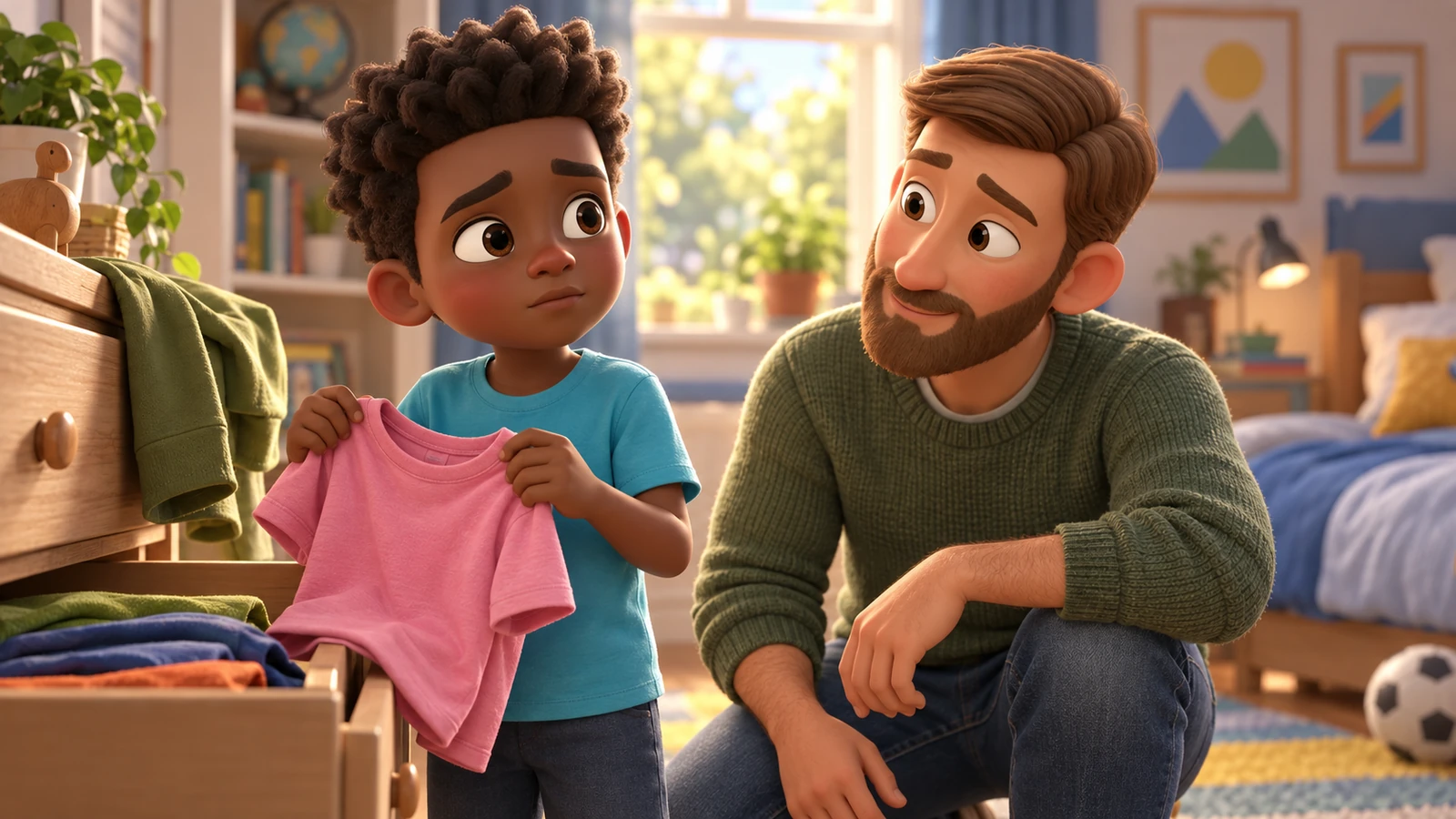
How do I help my son when kids make fun of him for liking pink?
Give your child one calm line to use and repeat: “I like it. Colors are for everyone.” Then help him walk off toward a friend instead of arguing. Practice it at home until it comes out easily, and tell the teacher if the same children keep it up.
Key takeaways
- “Pink is for girls” is usually a group testing a playground rule, and testing whether your child will react.
- Your child does not need to win the argument. One settled sentence, said once, is enough: “I like it. Colors are for everyone.”
- The same applies to any interest labeled “for girls” or “for boys”: dolls, dance, baking, football, skateboarding, short hair.
- At home, keep the question about your child: “Do you still like it? Then you get to keep liking it.”
- If it is the same children, day after day, or it turns into names and leaving him out, that is a pattern for the school.
Why “just ignore them” and “tell them they’re wrong” both fall short
Children pick up rules about what boys and girls “should” like very early. Raising Children Network describes gender stereotypes as ideas about who should play certain sports, who should wear what and who should show certain feelings. By school age, some children enforce those rules on each other. A boy in a pink shirt, a girl who plays tackle football, a boy who does ballet: to a seven-year-old rule-keeper, that is a rule being broken, and pointing it out feels like being right.
“Just ignore them” asks your child to stand there silently while a group laughs. Most children can’t do it, and the silence often reads as being hurt, which is what the teasing was fishing for. The opposite advice, explaining why they’re wrong, hands your child a debate at the worst possible moment. A nine-year-old’s lecture on stereotypes usually just gets a second round of laughing.
What works in between is a short line that does two things at once: it keeps the thing your child likes, and it shows the comment didn’t hit. There is nothing in it to argue with or apologize for. Then he walks off to something else. Nobody’s mind changes that day, but teasing him gets boring, and boring teasing tends to stop.
4 things your child can say when someone says “that’s for girls”
1.“I like it. Colors are for everyone.”
The main line. It states a fact about your child and a fact about colors, without calling anyone names. Works for clothes, backpacks, nail polish and pencil cases. Swap the word for the thing: “Sports are for everyone,” “Dance is for everyone.”
2.“Yep, it’s my favorite.”
For a child who wants something even shorter. Agreeing cheerfully takes the air out of the tease because there is no reaction to laugh at. It works best said with a shrug and followed by walking away.
3.“Why do you think that?”
A calm question from Raising Children Network’s list of things children can say about gender stereotypes. It turns the spotlight back on the teaser, who usually has no answer. Best for one child, not a crowd, and for kids who feel steady that day.
4.“Okay. Anyway…”
The exit line, for when your child doesn’t want to engage at all. It ends the exchange on his terms. Rehearse where he goes next (a friend, the game, the line-up) so walking off feels like his choice.
5 quick replies for the moment itself
1.“So?”
One word, flat and unbothered. It works for older kids who can deliver it without sounding upset, and it leaves the teaser nothing to build on.
2.“Lots of people like it.”
True, calm and hard to argue with. Useful when a group is involved, because it quietly reminds everyone that your child is not the only one.
3.“You don’t have to like it.”
Draws a line: your taste is yours, mine is mine. Good for kids who want to sound firm without sounding mean back.
4.“Football is fun. Want to play?”
For girls teased about sport, or boys teased about dance or dolls: inviting the teaser in makes the rule look silly without attacking anyone.
5.“I’m going to go play now.”
A plain exit for younger children. It gives them permission to leave a mean moment without needing a clever answer first.
What not to say (and what to say instead)
“Just ignore them.”
“Say ‘I like it’ once, then go find your friend.”
A silent, frozen child looks hurt; one short line plus walking away looks settled.
“Maybe wear the blue one tomorrow.”
“You can wear what you like. Want a line ready in case they say it again?”
Steering him away from pink teaches him the teasing worked; offering a line keeps the choice his.
“Tell them they’re being sexist.”
“Colors are for everyone.”
A label starts an argument a child can’t win on a playground; a plain fact ends it.
“They’re just jealous.”
“What did they say, exactly? What did you do?”
Details tell you whether this was one comment or a pattern, and the story helps your child feel heard.
(Your child) “No I don’t! I hate pink.”
(Your child) “Yep, I like it. So?”
Denying it invites a second round (“Yes you do!”), while owning it leaves nothing to push on.
| Instead of | Try | Why |
|---|---|---|
| “Just ignore them.” | “Say ‘I like it’ once, then go find your friend.” | A silent, frozen child looks hurt; one short line plus walking away looks settled. |
| “Maybe wear the blue one tomorrow.” | “You can wear what you like. Want a line ready in case they say it again?” | Steering him away from pink teaches him the teasing worked; offering a line keeps the choice his. |
| “Tell them they’re being sexist.” | “Colors are for everyone.” | A label starts an argument a child can’t win on a playground; a plain fact ends it. |
| “They’re just jealous.” | “What did they say, exactly? What did you do?” | Details tell you whether this was one comment or a pattern, and the story helps your child feel heard. |
| (Your child) “No I don’t! I hate pink.” | (Your child) “Yep, I like it. So?” | Denying it invites a second round (“Yes you do!”), while owning it leaves nothing to push on. |
What do I say when my child wants to stop wearing pink or quit dance?
Ask one question, calmly: “Do you want to stop because you don’t like it any more, or because of what they said?” But if the honest answer is “because of what they said,” say so gently: “That makes sense. It’s hard when people laugh. You still get to like it.”
Then let your child decide, and keep the door open. He might wear the pink shirt at the weekend and not to school for a while. She might keep football at the club and skip the lunchtime game. Neither is losing. Forcing him to wear the pink shirt to prove a point puts your cause on his shoulders. What matters is that at home nothing he likes is up for mockery, including from siblings, grandparents and you.
Raising Children Network also suggests pointing out people in non-stereotypical roles, such as men in pink, women in professional football and boys in ballet, and helping your child see themselves through their strengths and interests, not only their gender.
What do I say when the teasing doesn’t stop?
What if a whole group joins in?
Groups feed on reactions, so the line matters less than the exit. Practice the short version (“Okay. Anyway…”) and where your child goes next. Afterwards, ask who didn’t laugh. That child is worth building on.
What if the comment comes from an adult, like a coach or a relative?
Handle adults yourself; that is not your child’s job. A calm word in private usually does it: “He loves pink. Could you leave the ‘girls’ color’ jokes out?”
When should I involve the school?
When it is the same children again and again, when it spreads to names or leaving your child out, or when your child starts dreading school. Hurtful, repeated teasing crosses into bullying. Write down what happened and when, and ask the teacher what they see at recess. Tell your child that telling a trusted adult is how this gets fixed, and it counts as brave.
What if my child is the one saying “that’s for girls”?
Stay calm and curious rather than shocked. Ask how the other child might have felt, and what else your child could have said. Raising Children Network suggests separating the behavior from who your child is: a kind person who said something unkind can say sorry and do better.
What to say at 6–8, 9–11 and 12–14
- 6–8
- “Boy colors” and “girl toys” rules peak around now, and children repeat them without much malice. Keep lines short and cheerful, practice with toys or puppets, and give a clear exit. Tell the teacher early; at this age a class conversation about “colors are for everyone” can reset the rule for the whole room.
- “I like it. Colors are for everyone.”
- 9–11
- Teasing becomes more about status and fitting in. Offer a few lines and let them choose the one that feels like them; a flat “So?” or a shrug often works better than anything clever.
- “Yep, still my favorite.”
- 12–14
- Comments can get sharper and move into group chats, and some turn into put-downs about identity. Many teens want to handle it themselves; ask what would help rather than stepping in. Make sure they know which comments cross the line into something to report, online or at school.
- “Cool. I’m still wearing it.”
| Age | What changes | Line to try |
|---|---|---|
| 6–8 | “Boy colors” and “girl toys” rules peak around now, and children repeat them without much malice. Keep lines short and cheerful, practice with toys or puppets, and give a clear exit. Tell the teacher early; at this age a class conversation about “colors are for everyone” can reset the rule for the whole room. | “I like it. Colors are for everyone.” |
| 9–11 | Teasing becomes more about status and fitting in. Offer a few lines and let them choose the one that feels like them; a flat “So?” or a shrug often works better than anything clever. | “Yep, still my favorite.” |
| 12–14 | Comments can get sharper and move into group chats, and some turn into put-downs about identity. Many teens want to handle it themselves; ask what would help rather than stepping in. Make sure they know which comments cross the line into something to report, online or at school. | “Cool. I’m still wearing it.” |
Key terms
- Gender stereotype
- An idea about how people of a gender should behave, for example who should wear pink, do ballet or play football.
- Teasing
- Joking comments about someone. Playful teasing that both children find funny is common; teasing that is hurtful and constant is not.
- Exit line
- A short, rehearsed way to end the exchange and walk off, so the moment finishes on your child’s terms.
- Pattern
- The same children, the same comments, on several days. That is the point to involve the school rather than rely on a line.
Questions parents ask
What do I say to my son when kids say pink is for girls?
Start by listening: “What did they say? What did you do?” Then tell him plainly that colors are for everyone and he gets to keep liking what he likes. Give him one short line to use next time, such as “I like it. Colors are for everyone,” and practice it once at a calm moment.
Should I let my son wear pink to school if he might be teased?
Let him choose. If he wants to wear it, give him a line and an exit plan and let him go. If he would rather keep it for weekends for now, that is his call too, and nobody should treat it as a defeat.
Is it normal for kids to say things are “for girls” or “for boys”?
Yes, it is common, especially in the early school years when children are learning rules and love enforcing them. It is still worth answering, gently and consistently, at home and at school.
What if my daughter is teased for playing football or having short hair?
The same approach works: a calm, owning line (“Football is for everyone. Want to play?”), an exit, and attention to whether it is a pattern. Girls who play “boys’ sports” often find one teammate who backs them up changes a lot, so ask who that could be.
My son wants to quit dance because of teasing. Should I let him?
Ask whether he wants to stop because he no longer enjoys it or because of what others say. If it is the teasing, help with lines and involve the school, and consider letting him keep dance outside school while he decides. Try not to make the decision for him either way.
When does teasing become bullying?
When it is hurtful, repeated and one-sided: one child or a group with more social power keeps targeting another. Stopbullying.gov describes bullying as unwanted aggressive behavior with a real or perceived power imbalance that is repeated or likely to be repeated. At that point, involve the school rather than relying on comebacks.
Related
Sources
- Raising Children Network (Australia) — Healthy attitudes to gender: kids & teens (2026): Gender stereotypes include ideas about who should play certain sports and who should wear what; parents can give children things to say such as “That’s not fair” or “Why do you think that?”, point out people in non-stereotypical roles, and, if their own child behaves in a stereotyping way, calmly separate the behaviour from who the child is.
- Nemours KidsHealth — Helping Kids Deal With Bullies (2023): Most kids get teased at some point and playful, mutual teasing is not usually harmful; when teasing becomes hurtful, unkind and constant it crosses the line into bullying, and parents should let someone at school know.
- StopBullying.gov (U.S. Department of Health and Human Services) — What Is Bullying (2024): Bullying is unwanted, aggressive behavior among school-aged children that involves a real or perceived power imbalance and is repeated, or has the potential to be repeated, over time.