
Honesty scenarios for kids: 15 role-plays to practice at home
Life Scenario team · Published · Ages 6–14
What are some honesty scenarios for kids to role-play?
Good honesty scenarios are small and familiar: you knocked over a classmate's model and nobody saw, a friend's mom asks if you like the dinner, a cashier gives you too much change. Read one aloud, let your child answer, and practice a line such as “I did it. Can I help fix it?”
Practise a situation like this with your child — no sign-up →
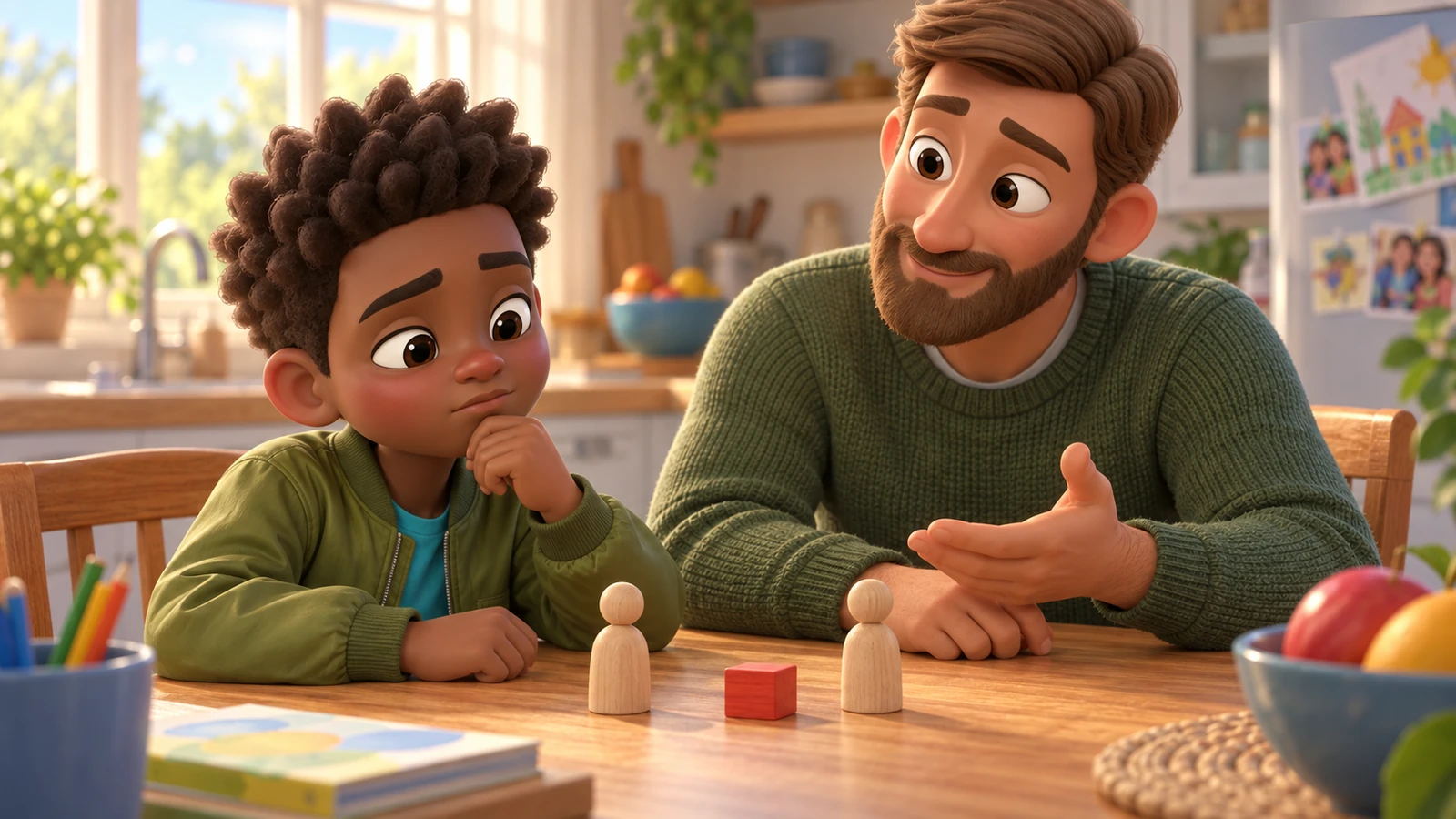
Key takeaways
- Use made-up situations. A role-play built on yesterday's real incident is an interrogation in disguise.
- Give every scenario a good ending for the honest answer. Children copy stories where telling the truth turns out well.
- Practice three kinds of honesty: owning up, being truthful and kind at once, and doing the right thing when nobody would know.
- Play the adult's part properly. A calm response to the truth is half of what your child is rehearsing.
- One scenario, five minutes, roles swapped. Then stop.
How to run an honesty role-play in five minutes
Pick one scenario from the lists below and read it aloud. Ask, “What would you say?” Let your child answer in their own words before you offer anything. If they are stuck, give them the suggested line and let them try it.
Then answer as the other person would. This part matters as much as their line. If you are playing the parent who has just been told about a broken vase, respond the way you would want to on a good day: “Thank you for telling me. Let's clean it up.” Your child is finding out what happens after the truth.
Swap roles. Let your child be the parent or the friend, and you be the one who has to own up. Many children enjoy this, and hearing an adult say “I did it, I'm sorry” does more than any explanation.
Keep it fictional. If you need to find out what really happened to the missing chocolate, ask about it directly at another time. A child who suspects the game is a trap will stop playing it honestly.
5 honesty scenarios about owning up
1.“You knocked over a classmate's model. Nobody saw.”
Try: “I knocked it over. I'm sorry. Can I help fix it?” It names what happened and offers a repair, which gives the other child something better than an excuse.
2.“You said your homework was done. It isn't.”
Try: “I said it was done and it's not. I have one page left.” Correcting a lie that is already out is harder than avoiding one, so it needs its own practice.
3.“You ate the last cookies. Your brother is getting blamed.”
Try: “It wasn't him. It was me.” Short on purpose. The longer the sentence, the more room there is for an excuse to creep in.
4.“You lost the library book. The teacher asks where it is.”
Try: “I've lost it. I looked at home and couldn't find it.” It says what is true and what your child has already done about it.
5.“You were on the tablet after bedtime. Mom asks why you're tired.”
Try: “I was on the tablet late. I should have stopped.” Rehearse the parent's calm reply too, or the scenario teaches the opposite lesson.
5 honesty scenarios about being truthful and kind
1.“A friend's mom asks if you like the dinner. You don't.”
Try: “It's not my favorite, but thank you for making it.” Or find the true part: “I really like the potatoes.” Honest does not have to mean every thought.
2.“Grandma asks if you love the sweater she knitted.”
Try: “Thank you for making it for me.” Thanks for the effort is true even when the sweater is itchy, and your child has not had to pretend.
3.“A friend asks if you like her new haircut. You don't.”
Try: “It's different! I liked the old one too.” Children need to hear that they can be gentle without saying something false.
4.“A friend asks why he wasn't invited to your party.”
Try: “I could only ask four people. I'm sorry it wasn't you.” A real reason, said kindly, hurts less than an invented one that comes apart later.
5.“A teammate asks if they played badly. They did.”
Try: “It wasn't your best game. Your passing was good, though.” It practices saying a hard thing and a true good thing in the same breath.
5 honesty scenarios about doing the right thing
1.“The cashier gives you too much change.”
Try: “Excuse me, I think you gave me too much.” A good first scenario for this group, because the right answer costs your child a little and nobody would ever have known.
2.“You find a ten-dollar note on the playground.”
Try: “I found this. Who should I give it to?” Handing it to a teacher is the action. The sentence is short so the action is easy to start.
3.“A friend wants you to say he was with you. He wasn't.”
Try: “I'm not going to lie for you, but I won't make it worse.” Covering for a friend is the hardest case for older children, so let them try several versions.
4.“The teacher marks an answer right that you got wrong.”
Try: “I think this one should be marked wrong.” Play the teacher as pleased, so the honest answer gets a good ending.
5.“Everyone says they finished the book. You didn't.”
Try: “I'm on chapter six.” It practices being the one person in the room who says the unimpressive truth, which takes nerve at any age.
Reading a scenario at the kitchen table is the warm-up. In Life Scenario your child hears a moment like this one: you're having dinner at a friend's house, you really don't like the food, and your friend's mom asks, “Do you like it?” They answer in their own words, get gentle feedback and can try again. About this practice scenario
No sign-up · about 2 minutes
What not to say (and what to say instead)
| Instead of | Try | Why |
|---|---|---|
| “Let's pretend you broke a window. Like you did on Tuesday.” | “Let's pretend a girl called Asha broke a window.” | A scenario about the child's own recent mistake feels like a trial. A made-up child keeps it safe to try answers. |
| “Wrong. An honest child would say…” | “What do you think would happen next if you said that?” | Following the lie forward lets the child see the problem themselves, which sticks better than a correction. |
| “You must always tell the whole truth.” | “Say what's true, and say it kindly.” | “The whole truth” told to a seven-year-old produces “your cooking is disgusting”. Truthful and kind is the actual goal. |
| “See? Lying always gets found out.” | “You told the truth and it got sorted. How did that feel?” | Threats about getting caught teach caution. A good outcome for honesty teaches honesty. |
Why should honest answers get a good ending?
Because that seems to be what works. In a 2014 study in the journal Psychological Science, researchers led by Kang Lee tested whether four classic moral stories made children aged 3 to 7 more honest. “Pinocchio” and “The Boy Who Cried Wolf”, which show lying being punished, did not reduce lying. The story of George Washington and the cherry tree, in which a child owns up and is praised for it, increased truth-telling. When the researchers rewrote that story to end badly for the liar instead, the effect disappeared.
A second study, by some of the same researchers, points the same way. In 2015, Talwar, Arruda and Yachison found that children aged 4 to 8 told the truth more often when an adult said they would be pleased to hear it, and that an appeal to the child's own sense of right worked better when no punishment was expected.
For role-play, the lesson is practical. Play the parent, teacher or friend as someone who takes the truth well. Raising Children Network recommends the same thing in real life: praise a child for owning up, then work out together how to put things right.
What do I say when my child gives a dishonest answer in the role-play?
Stay in the scene. If your child, playing themselves, says “It wasn't me”, answer as the friend would: “Oh. But I saw you near it.” Let them feel where the lie leads, then offer a second take: “Want to try a different answer and see what happens?”
Do not turn it into a talk about their character. It is a game, and trying out the wrong answer in a game is a safe way to find out why it does not work. Some children say they would lie simply to see your reaction. A calm “Okay, let's see how that goes” is enough.
Use the scenario to reach the next skill. Owning up usually needs an apology, so see what to say instead of a forced sorry. Scenarios about covering for a friend are really about pressure from friends. And if your child worries that telling the truth about someone else is snitching, go through the difference between tattling and telling.
What if honesty is the hard choice?
What if my child says they would lie in real life?
Thank them for the honest answer, because it is one. Ask what they are afraid would happen if they told the truth. Often it is your reaction. That tells you what to change, and it is worth more than a correct answer in a game.
What if the truth would hurt someone's feelings?
Teach the difference between lying and choosing what to say. Your child can find something that is both true and kind, or can say “I'd rather not say”. They do not have to announce every opinion to be honest.
What if telling the truth gets a friend in trouble?
Separate small things from unsafe ones. For small things, your child can refuse to lie without volunteering information. If someone could get hurt, they tell an adult, and you make clear that this is what a good friend does.
What if a scenario brings up something real?
Stop the game and listen. If your child tells you about something they did, start with “Thank you for telling me.” If they tell you about something done to them, take it seriously, stay calm and get help from the school or your doctor as needed.
What to say at 6–8, 9–11 and 12–14
| Age | What changes | Line to try |
|---|---|---|
| 6–8 | Use toys or puppets and the owning-up scenarios: spills, breakages, the last cookie. Keep the honest line to a few words and make the pretend adult warm. | “I did it. I'm sorry.” |
| 9–11 | Add the truthful-and-kind scenarios: the dinner, the haircut, the party list. Children this age enjoy arguing about where the line is, and that argument is the practice. | “It's not my favorite, but thank you.” |
| 12–14 | Use the scenarios about friends and pressure: covering for someone, a wrongly marked test, a group claim that is not true. Discuss them more than act them, and ask what they have seen happen. | “I'm not going to lie for you.” |
Key terms
- Role-play
- Acting out a made-up situation for a few minutes so a child can try an answer before they need it for real.
- Owning up
- Saying what you did before or soon after being asked, and offering to put it right.
- White lie
- An untrue statement made to spare someone's feelings. The alternative taught here is to find something that is both true and kind.
- Second take
- A chance to give a different answer in the same scene, with no penalty for the first one.
Give your child 5 free practice scenarios
No card to start. No subscription, ever.
Try one short round together. Your child hears a situation such as being asked by a friend's mom whether they like a dinner they do not like, says what they would do, and gets gentle feedback with a chance to try again. You get a few prompts for a short conversation afterward.
Start practising freeQuestions parents ask
What are some honesty scenarios for kids?
You broke something and nobody saw. You said your homework was done and it is not. A cashier gives you too much change. A friend asks if you like a haircut you do not like. A friend wants you to cover for him. This page has fifteen, each with a line to try.
How do I teach honesty through role-play?
Read a short made-up situation, let your child answer, respond as the other person would, then swap roles. Make sure the honest answer leads to a good ending in the scene. Five minutes, one scenario, a few times a week is enough.
What do I say when my child asks if a white lie is okay?
“You don't have to say everything you think. You do have to make sure what you say is true.” Then practice finding the true, kind thing: thanks for the effort, or one part they did like.
What do I say when my child tells the truth about something bad?
“Thank you for telling me. That took courage.” Say it before anything else. Then deal with what happened, calmly. If the truth is met with anger, your child will be slower to offer it next time.
Do stories about lying teach honesty?
It depends on the story. In a 2014 study, stories that showed lying being punished did not reduce lying in children aged 3 to 7, and a story in which a child was praised for telling the truth did increase it. Choose stories and scenarios where honesty ends well.
What honesty scenarios work for older kids and teens?
Ones with friends in them: being asked to cover for someone, a group that claims something untrue, a test marked wrongly in their favor, a rumor they know is false. Discuss them as dilemmas instead of acting them out.
Should I use a real incident as a scenario?
No. Children can tell, and the role-play becomes a way of catching them out. Use invented names and situations. If you need to find out about a real event, ask directly at a different time.
Sources
- Psychological Science (Lee, Talwar, McCarthy, Ross, Evans & Arruda) — Can classic moral stories promote honesty in children? (2014): Among children aged 3–7, “Pinocchio” and “The Boy Who Cried Wolf” did not reduce lying, while “George Washington and the Cherry Tree”, which emphasizes the positive consequences of honesty, significantly increased truth-telling; a version rewritten to stress negative consequences did not.
- Journal of Experimental Child Psychology (Talwar, Arruda & Yachison) — The effects of punishment and appeals for honesty on children's truth-telling behavior (2015): In a study of 372 children aged 4–8, appeals that told children the adult would be happy if they told the truth increased truth-telling, and an internal appeal was more effective when children did not expect punishment.
- Raising Children Network (Australia) — Children & lying: why do kids lie & what to do about it (2025): Parents can encourage honesty by having conversations about lying and telling the truth, praising a child for owning up, and being a role model for telling the truth.
- Child Mind Institute — Why Kids Lie and What Parents Can Do About It (accessed 2026): Children lie for different reasons, including to gain approval and to spare someone's feelings; parents are advised to praise truth-telling and to avoid calling a child a liar.
- American Academy of Pediatrics / HealthyChildren.org — When Children Lie: What Parents Can Do (2025): A parent's own way of telling the truth is among the most important ways to teach honesty, and children can be confused when adults who forbid lying tell white lies themselves.
Published