
“How do I teach my child to be kind?” Words for ordinary moments
Life Scenario team · Published · Ages 6–14
How do I teach my child to be kind?
Teach kindness the way you would teach a sport: show it, give your child one small thing to do, and repeat. Start with a line they can use tomorrow, such as “Do you want to sit with us?” or “Are you okay?”, and tell them what you noticed when they use it.
Practise a situation like this with your child — no sign-up →
Key takeaways
- Children learn kindness mainly from how the adults around them treat people, including people who cannot do anything for them.
- “Be kind” is too vague to act on. One line for one situation is something a child can do.
- Say plainly that being kind matters as much as being happy or doing well. Many children do not hear that message.
- Expect everyday helping without a prize, and save your praise for kindness that took some courage.
- Kind does not mean giving in. A kind child can still say no and can still tell an adult.
Why telling a child to “be kind” does not work
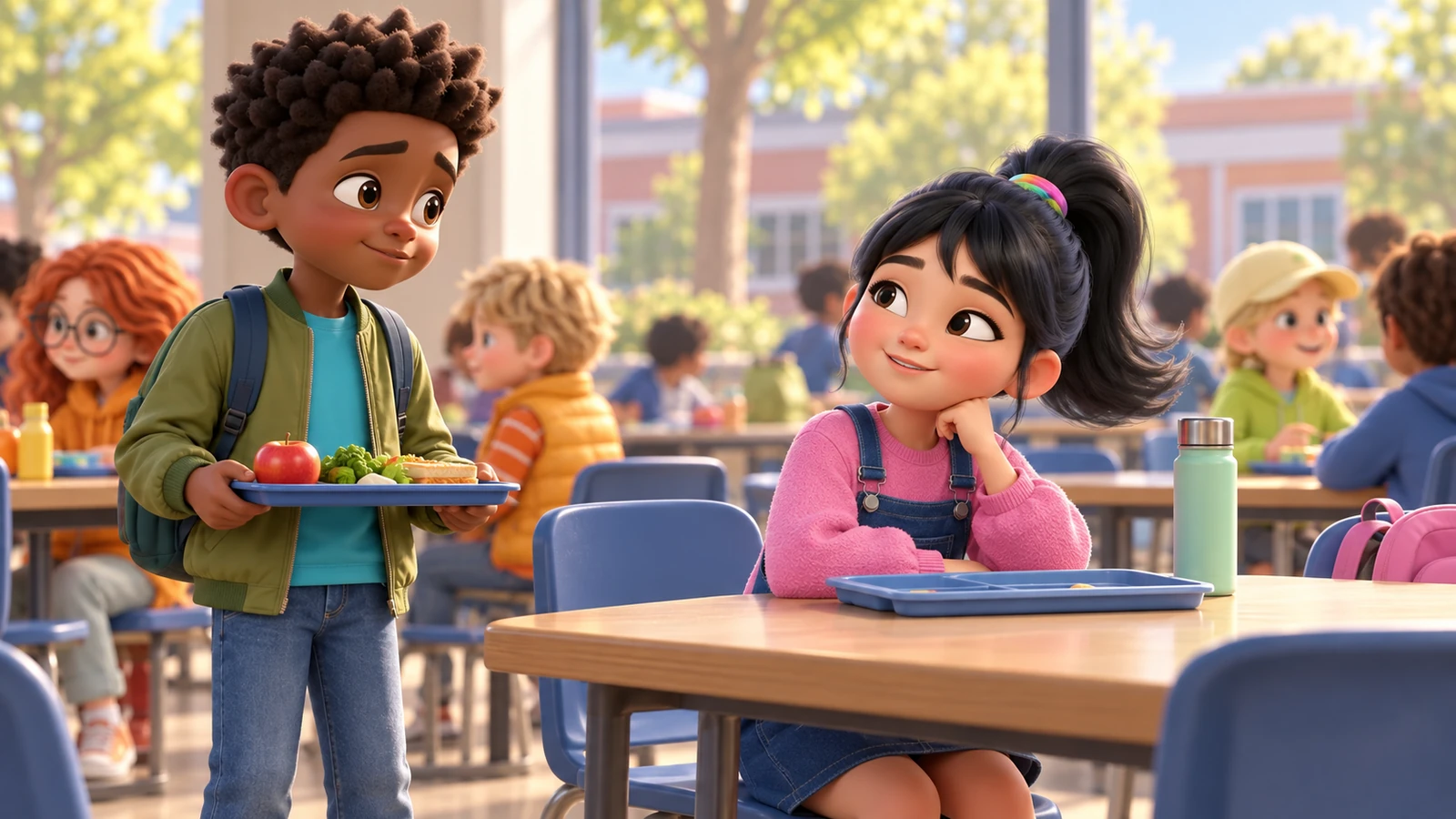
“Be kind” is an instruction about a whole personality. A child at a lunch table needs something much smaller: what to say to the girl with the tray who has nowhere to sit. Without a sentence ready, many children do nothing.
Children also learn from what we appear to value. Making Caring Common, a project at the Harvard Graduate School of Education, notes that most parents say raising a caring child is a top priority, and that children often do not hear that message. Its suggested fix is a small change of wording. In place of “the most important thing is that you're happy”, try “the most important thing is that you're kind and that you're happy.”
The rest is practice. The same Harvard guide compares learning to care with learning a sport or an instrument: it takes daily repetition and gradually harder challenges. The American Academy of Pediatrics adds the other half, which is that children learn to be kind by watching, so how you speak to the delivery driver and about the neighbor is part of the lesson.
6 kind things your child can say tomorrow
1.“Do you want to sit with us?”
For a child alone at lunch or new in class. It is a question, so the other child can decline, and your child has done the kind thing either way.
2.“Are you okay?”
For a classmate who has been teased, has fallen over or looks upset. Two words are enough to show that someone noticed, which is often what the child needed.
3.“Come and play with us.”
For a child who has just been left out or laughed at. It moves them away from the unkind moment and into a game, without a confrontation.
4.“Do you want help, or are you okay?”
For someone struggling with a bag, a zip or a task. Asking first respects the other child, who may want to manage alone.
5.“You can go after me.”
For games and queues. It shares a turn without giving up your child's own, which shows that being kind and being fair to yourself fit together.
6.“Sorry I left you out. Want to join now?”
For putting it right. Kind children are unkind sometimes too, and the repair is a skill worth practicing as much as the invitation.
Knowing a kind line is the first half. Using it while a friend is standing right there is the second. In Life Scenario your child hears a moment like this one: in the cafeteria line your friend says he only wants to hang out with certain kids, and another student hears it and looks hurt. They answer in their own words, get gentle feedback and can try again.
No sign-up · about 2 minutes
What not to say (and what to say instead)
| Instead of | Try | Why |
|---|---|---|
| “Go and be nice to that lonely boy.” | “He's on his own. You could ask if he wants to play.” | “Lonely” is a label the other child would hate to overhear. A suggestion about one sentence leaves both children their dignity. |
| “You have to share your new toy.” | “Which toys are you happy for her to use?” | Forced generosity teaches resentment. A choice about what to share is still sharing, and the child owns it. |
| “If you're kind, everyone will like you.” | “Being kind is right even when you get nothing back.” | Kindness sold as a way to be popular falls apart the first time it is not returned. |
| “That was so kind! Here's a sticker.” | “I saw you ask her to join. That took nerve.” | A prize makes the prize the goal. Saying what you saw tells the child exactly what to repeat. |
| “Why are you so mean to your sister?” | “That hurt her. What could you do to fix it?” | “Mean” describes the child. Naming the effect and asking for a repair gives them a way back. |
5 habits at home that teach kindness
Let them see you do it. Thank the bus driver by name. Speak about a difficult relative without contempt. When you snap at your child, say so and apologize. Making Caring Common lists this kind of honesty about our own mistakes as part of being a role model.
Ask one question a day. Its suggestion for the dinner table is simple: what is something nice someone did for you today, and what is something nice you did? A child who knows the question is coming starts looking for answers during the day.
Give real jobs. The same guide advises expecting children to help routinely, with chores and with siblings, and praising only the uncommon acts of kindness. Kindness that is expected and not rewarded is more likely to become a habit.
Widen the circle. Most children are kind to their friends. The harder step is someone outside the group: a new child, a child who does not speak the language well, a child who sits alone at lunch. Ask your child who in their class might be having a hard time, and what one small thing could help.
Rehearse one situation. Pick the moment most likely to come up, such as a new classmate at the next table, and play it through once at home. You be the new child. Let your child try the line, then swap.
What do I say when my child was unkind?
Keep it short and aim at the repair. “You told her she couldn't play. How do you think that felt? What could you say tomorrow?” A long talk about what kind of person they are teaches shame, and shame makes children defensive.
Look for the reason. Sometimes a child is unkind because a friend expected it of them. If your child left someone out to stay in with a group, the thing to practice is handling pressure from friends, with a line such as “I'm going to ask her anyway.”
Check the other direction as well. Some children are so anxious to be kind that they give away their turn, their snack and their say. They need to hear that they can be kind and still stand up for themselves without being mean. With younger children the same question usually shows up over sharing toys at a playdate.
What if kindness is difficult or not returned?
What if the other child says no or is rude back?
Your child did their part. Tell them so: “You asked. That was the kind bit. Her answer is up to her.” They do not need to keep trying with a child who is repeatedly unkind to them.
What if my child is only kind when adults are watching?
Do not make too much of it. Keep modeling, keep asking the daily question, and notice kindness you were not meant to see. Avoid setting traps to catch them out, which teaches them to perform.
What if friends pressure my child to leave someone out?
Practice a line that does not require a speech: “I'm going to sit with her today.” Your child does not have to confront the group. If the exclusion is organized and repeated, tell the teacher, because the excluded child needs adults to step in.
When should I involve the school or a professional?
Speak to the teacher if your child is repeatedly cruel to others, or is on the receiving end of it. If hurting others continues despite clear limits and repair, ask the school counselor or your child's doctor for advice.
What to say at 6–8, 9–11 and 12–14
| Age | What changes | Line to try |
|---|---|---|
| 6–8 | Kindness is concrete at this age: a seat, a turn, a hand with a coat. Give one line and stay close. Remind them to listen to the answer, because an invitation does not give permission to grab or hug. | “Do you want to play with us?” |
| 9–11 | Groups form and leaving people out begins. This is the age for the harder kindness: speaking to the child who was laughed at, or inviting someone the group ignores. | “Are you okay? That wasn't fair.” |
| 12–14 | Much of it moves online. Kindness can be a private message to someone who was mocked in the group chat, or simply not adding to the pile. Respect that they will not want it made public. | “That was harsh. You okay?” |
Key terms
- Kindness
- Doing or saying something for another person's good, taking account of what they actually want.
- Empathy
- Working out what another person may be feeling. Asking is usually more accurate than guessing.
- Circle of concern
- The people a child cares about. Making Caring Common uses the phrase for the aim of widening that group beyond family and close friends.
- Boundary
- A limit on time, belongings, space or touch. A child can be kind and keep their own limits.
Give your child 5 free practice scenarios
No card to start. No subscription, ever.
Try one short round together. Your child hears a situation such as a friend saying he will hang out with certain kids and no others, while another student overhears, says what they would do, and gets gentle feedback with a chance to try again. You get a few prompts for a short conversation afterward.
Start practising freeQuestions parents ask
How can I teach my child to be kind to others?
Show it yourself, give them one specific line for one situation, and ask about it afterward. Children pick up kindness from watching adults and from repeated small practice. A general instruction to be nice gives them nothing to do.
How do I teach a young child to be kind?
Use concrete actions: offering a seat, passing a toy, asking “Are you okay?” Practice with toys at home, name what you see them do, and keep it to one idea at a time. Young children copy what you do with them and in front of them.
What do I say when my child refuses to include someone?
Find out why first. Children are allowed to have closer friends. Explain the difference between choosing who to play with and shutting someone out of a shared game, and ask what they could say that is honest and kind, such as “I'm playing with Sam now. Want to play at lunch?”
Should I reward my child for being kind?
Mostly no. Harvard's Making Caring Common advises expecting routine helpfulness and praising only uncommon acts of kindness. Say what you noticed instead of handing out prizes, so the kindness does not become a way to earn something.
Can a child be too kind?
A child who always gives in, cannot say no and takes the blame to keep the peace is being compliant more than kind. Teach them that kindness includes themselves: they can share and still keep a turn, and help and still say “not now”.
What do I say when my child was kind and got nothing back?
“You did the right thing, and you did it without a reward. That's the hard kind.” Do not promise it will be returned next time. Help them notice who does respond warmly, because those are the children worth their effort.
What are some kindness activities for kids at home?
A daily dinner question about one kind thing given and one received, a thank-you note for a specific act, a regular chore that helps someone else, and one rehearsed line for a situation at school. None needs materials, and all four can start this week.
Sources
- Making Caring Common, Harvard Graduate School of Education — 7 Tips for Raising Caring Kids (2018): Most parents say children being caring is a top priority, yet children often do not hear that message; caring takes daily practice like a sport or an instrument; children should be expected to help routinely with praise kept for uncommon acts of kindness; parents should help widen the child's circle of concern, for example to a new child in class.
- American Academy of Pediatrics / HealthyChildren.org — Kindness: How a Simple Act Can Make a Big Difference (2022): Children learn to be kind by watching adults; parents can suggest simple acts such as comforting a classmate who is being teased or reaching out to a new student with company at lunch or a smile and hello.
Published